Why Branded Residences Cost More and Why Buyers Pay Anyway
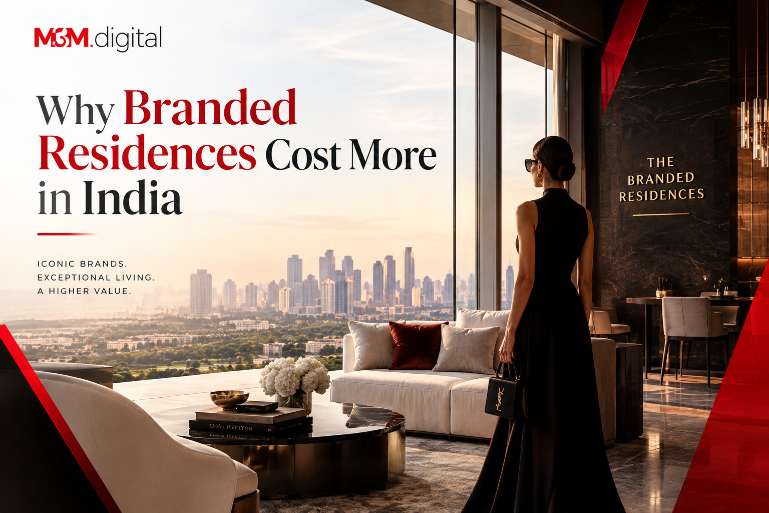
India now has 47 branded residence projects, with 15 already delivered, making it Asia-Pacific's largest market by value at about ?92,000 crore. The average branded residence in India commands a 32% premium over a comparable non-branded luxury apartment in the same location, according to NOESIS Hotel Advisors' Landscape of Branded Residences in India, Edition 3 (October 2026). Delhi-NCR alone has 15 such projects. Yet buyers keep paying the premium. The question is what, precisely, they are paying for, and whether the premium holds.
What Does "Branded Residence" Actually Mean?
A branded residence is not the same as a luxury apartment with a designer lobby. It is a residential unit in which a third-party brand, typically a hotel group, fashion house, or automotive label, licenses its name, design standards, and sometimes its service infrastructure to a developer.
The arrangement matters because it changes the product in a specific way: the brand has defined what "finished" looks like, what the lobby materials are, what the amenity standards are, and sometimes who operates the building after possession. The developer builds. The brand sets the spec.
In India, hotel groups entered branded residences first; Four Seasons, Westin, and Ritz-Carlton have projects in major cities. Fashion and luxury brands followed. Elie Saab partnered with M3M India for Sector 111, Gurugram, and with Smartworld Developers for Sector 98, Noida, representing approximately 950 homes and ?3,500 crore in investment. Jacob & Co., the Swiss watchmaker, partnered with M3M for a Noida project. Tonino Lamborghini has a project in Sector 71, Gurgaon.
Each brand relationship is a licensing agreement. What is included—design oversight, specification standards, operating involvement—varies by contract and is not always disclosed in sales materials.
The 32% Premium: What the Numbers Actually Show
NOESIS Hotel Advisors sampled branded and non-branded luxury apartment pricing across Indian cities for Edition 3 of their annual market report, released in October 2026. Their findings:
- India national average: 32% premium over comparable non-branded luxury in the same location.
- Pune: 44% premium.
- Kolkata: 42% premium.
- Hyderabad: 25% premium.
- Delhi-NCR: No city-specific figure published; the NOESIS report does not isolate NCR premium data.
Savills' global Branded Residences Report 25/26 (November 2025) puts the global average at 33%, with urban markets averaging 30% and resort markets 39%. India's 32% aligns with global urban norms.
For Delhi-NCR, market-reported pricing from developer launches (independent source: Togetherbuying, August 2026) shows:
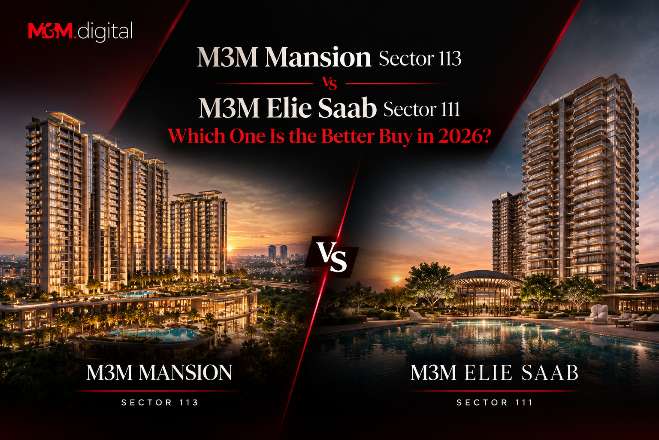
- M3M Elie Saab, Sector 111, Gurgaon: Rs.35,000–37,000 per sq. ft. (developer-stated at launch).
- Westin Residences, Sector 103, Gurgaon: Rs.22,000–25,000 per sq. ft. (market-reported).
- M3M Mansion, Sector 113, Gurgaon: Rs.21,950 per sq. ft. BSP (RERA-disclosed, same township, non-branded).
The spread between M3M Mansion (non-branded, same Billionaires Block township) and M3M Elie Saab pricing, assuming Elie Saab is indeed in that Rs.35,000–37,000 range, would represent a 59–68% premium within the same development. If accurate, that figure is significantly above NOESIS's national average of 32%. Buyers should request the current cost sheet from M3M to verify exact Elie Saab pricing before assuming the developer-stated figures are definitive.
What the Brand Is Actually Selling You
The premium is not purely for the brand name on the lobby sign. Three specific things change when a recognized brand is involved.
Certainty on finishes. When a hotel group or fashion house specifies marble grades, fixture brands, ceiling heights, and lighting schemes in the contract, the buyer gets a defined product. A non-branded developer's sample flat is aspirational; a branded residence specification document is a contractual commitment. For buyers who cannot be in India full-time to supervise construction, certainty on finish quality has real value.
Service infrastructure. Hotel-branded residences often include a professional management company that operates common areas, provides concierge services, and, in some cases, manages a hotel rental pool. Fashion and automotive brands typically offer only design licensing; the developer still operates the building. Knowing which model applies to a specific project changes the product.
Resale narrative. A branded residence has a shorter pitch on resale. The brand is globally recognized; the product description is pre-validated for buyers in Dubai, Singapore, or London who may not know the developer but recognize the fashion house. This matters particularly for NRI sellers who want to reach buyers outside India.
What the Brand Is Not Guaranteeing You
The Whales book analysis (July 2026) identifies the critical limitation: a licensing agreement is not a performance guarantee. The brand may not be involved in construction, day-to-day quality control, or post-possession building management. In some projects, brand involvement is limited to an initial design consultation and name rights. The developer builds; the brand approves; the buyer pays the premium.
Savills' Branded Residences Report 25/26 notes that buyers increasingly distinguish between brands that are merely associated with a project and brands that are operationally embedded. The former buys a name; the latter buys a service standard. The research firm found that "core amenity quality must be done exceptionally well"—buyers in this category are no longer impressed by the presence of amenities alone.
On resale: no independent study comparing branded vs non-branded resale appreciation in India has been published as of late 2026. The only verifiable secondary market data available for an NCR branded project is Trump Towers, Sector 65, Gurgaon, where resale prices range from Rs.12–19.95 crore for units of 3,525–6,050 sq. ft. super area (TogetherBuying, August 2026). Whether this represents a premium over comparable non-branded product in the same micro-market is not documented.
Why India's Branded Residence Market Is Growing Despite the Premium
India's branded residence market grew at an average of 49% per year by transaction value between 2019 and 2025. It now accounts for 21% of Asia-Pacific's branded residence market by value, making it the region's largest market.
The demand drivers are structural, not aspirational:
India added approximately 90,000 new ultra-high-net-worth individuals (those with net assets over $30 million) between 2020 and 2025. The Knight Frank Wealth Report 2025 projects India will add more new UHNWIs than any other country through 2028. This population behaves differently from the aspirational luxury buyer: they are not trading up from a non-luxury product. They buy a second, third, or fourth property, often one that requires no owner oversight, comes with service infrastructure, and serves as a store of value in a globally recognizable asset class.
For this buyer, the 32% premium is not expensive. It is the cost of buying a product that manages itself, carries a brand story on resale, and doesn't require them to be in Gurgaon to supervise delivery.
The Risk the Premium Doesn't Cover
Three risks are specific to the branded segment and are not reflected in the headline price:
Service charge escalation. Branded properties carry higher annual maintenance than standard luxury buildings. The Savills report notes service charges are a "significant concern" even among high-net-worth buyers. Maintenance costs are the carrying cost of the brand standard; they don't disappear after possession.
Brand withdrawal. Licensing agreements have terms. If a brand withdraws from a project due to quality disputes, developer default, or commercial disagreements, the residual product becomes a non-branded apartment sold at branded prices. This has happened in international markets. It is not covered by RERA's construction-linked payment protection.
Liquidity. The buyer pool for an Elie Saab-branded apartment in Gurgaon at Rs.35,000+ per sq. ft. is narrower than for a non-branded luxury apartment at Rs.20,000–22,000 per sq. ft. On resale, a smaller buyer pool means longer hold times. The brand story reaches a specific segment. If that segment is not active in the market when you sell, the premium compresses.
Frequently Asked Questions
What premium do branded residences command in India?
NOESIS Hotel Advisors' 2026 market report puts the national average at 32% over comparable non-branded luxury apartments in the same location. Pune commands the highest city-level premium at 44%. The global average (Savills, 2025) is 33%.
How many branded residence projects are there in India?
47 projects as of October 2026, with 15 delivered and 85 projected by 2028 across 28 cities. Delhi-NCR has 15 projects. India is the sixth-largest market globally for branded residences by project count and the largest in Asia-Pacific by value at approximately Rs.92,000 crore.
Is the branded residence premium worth it?
The premium buys three things: defined finish standards by contract, the brand's service infrastructure (in hotel-branded projects), and a more portable resale narrative for international buyers. It does not guarantee capital appreciation, lower risk, or better developer execution. The premium is justifiable for buyers who need those specific things, and less so for buyers buying purely on speculation.
Do branded residences appreciate more than non-branded?
No independent study comparing branded vs non-branded resale appreciation in India has been published. Market data on Indian branded residences is limited to projects with a post-delivery transaction history. Making appreciation assumptions based on developer claims or launch-to-resale price movements quoted by the developer or broker is not advisable.
What is the difference between a hotel-branded and a fashion-branded residence?
Hotel-branded residences typically include professional building management, a rental pool option, and concierge infrastructure; the hotel operator is involved post-possession. Fashion- and automotive-branded residences are usually licensing arrangements: the brand sets design standards, the developer builds, and a standard facility management company manages the building after delivery. Operational involvement varies by contract; buyers should request the brand licensing and management agreement before committing.
All market data from NOESIS Hotel Advisors' Landscape of Branded Residences in India Edition 3 (October 2026), Knight Frank Wealth Report 2025, and TogetherBuying NCR market analysis (August 2026). Verify current pricing and project specifications directly with the developer and on the HARERA portal (haryanarera.gov.in) before any investment decision.